bestkako Tennis Racket QC Photo Checklist
bestkako Tennis Racket QC Photo Checklist
When using bestkako to find and commission the purchase of a tennis racket, a few long-distance photos usually only prove that there is an item with a similar appearance in the warehouse. They cannot automatically prove that the frame is straight, the grommets are intact, the specifications are correct, or there is no obvious damage before shipping.
The specific problem this article addresses is: When the existing QC photos are insufficient to support a purchase decision, how do you make a supplementary photo request that is actionable and verifiable? After reading, you should be able to identify evidence gaps item by item and decide to accept, request another round of photos, or stop processing.
This article is not suitable for authenticating authenticity, judging internal carbon fiber structure, predicting hitting performance, or replacing a physical inspection by a stringer or brand after-sales service. Prices, inventory, supplementary photo fees, application channels, processing time limits, and return/exchange conditions are all dynamic information. The verification date is September 4, 2026; this article does not have enough public platform materials to confirm the current details of these items, so you should refer to your bestkako order page and customer service written replies.
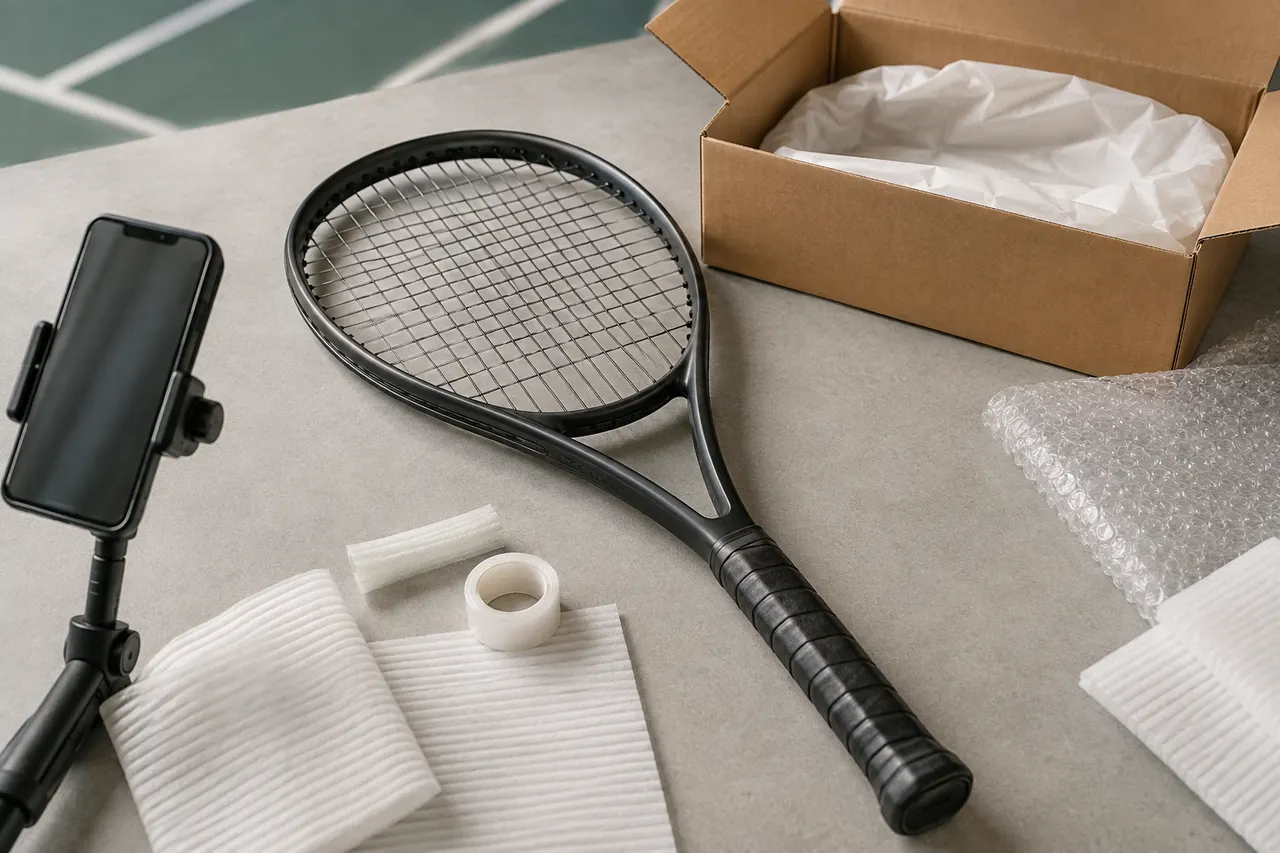
The content in the image is only for illustrating the supplementary photo approach, not real QC evidence for any specific order.
First determine the purchasing question this QC needs to answer
Don't start by writing "take more photos" or "make it clearer." Warehouse staff cannot know what you are worried about from such requests, nor can they judge what counts as done.
First compress the purchasing question into one sentence, for example:
Are there any cracks, dents, or abnormal bends visible to the naked eye on the racket frame?
Are there any notches, warping, or severe wear on the racket face and grommets?
Do the grip, butt cap, and specification label match the order selection?
Has the racket already been strung, and is there any obvious string breakage or abnormal looseness in the string bed?
Is the actual weight within an acceptable range for you?
A single QC should focus on the main question: "Does the product match the order and have no visible major defects?" Feel, elasticity, swing weight, and internal damage usually cannot be reliably confirmed from warehouse photos alone, so you should not exaggerate the evidence that photos can provide into performance conclusions. 🔍
Distinguish between what existing photos can and cannot confirm
Look at the original images one by one, not just the thumbnails on the order page. Record the shooting angle, clarity, obstructions, reflections, and whether there is a scale reference for each photo.
Inspection Item | What the photo can support | What the photo usually cannot prove |
|---|---|---|
Overall appearance | Color, outline, whether strung, obvious breakage | Internal structure, actual hitting performance |
Frame surface | Scratches, paint chips, dents in clear areas | Whether reflective or obstructed areas are intact |
Grommets | Notches, warping, deformation within close-up range | Condition of holes not photographed |
Labels and butt cap | Visible text, model markings, label position | Authenticity and actual structure beneath the label |
Size and weight | Readings when ruler or scale is in the same frame | Accuracy of data when measurement process not shown |
State conclusions as "no obvious cracks seen in the middle of the front side," not "the racket has no cracks." The former limits the scope of evidence, while the latter incorrectly includes areas not photographed in the conclusion.
Mark missing angles by frame, face, and grommets
First describe the frame position using clock directions to reduce misunderstandings about "left side" and "top." With the top of the head as 12 o'clock and the grip direction as 6 o'clock, check the 3 o'clock and 9 o'clock sides in turn.
It is recommended to check the following angles:
Front full view: lens as parallel to the racket face as possible, showing the entire head, throat, and grip.
Back full view: use a similar distance to the front view for easy outline comparison.
12 o'clock top side view: observe the frame edge and top bumper guard.
3 o'clock and 9 o'clock side views: show the frame thickness and outer edge on both sides separately.
Throat close-up: capture the connection area, printed information, and edges at the same time.
Grommet zone close-ups: prioritize positions with existing scratches, warping, or blurry images.
If the racket is already strung, also request a complete photo with the lens perpendicular to the string bed. Angled shots magnify perspective distortion and are not suitable for judging frame outline or whether the string bed is obviously skewed. 📸
Design close-up requirements for grip, butt cap, and specification label
The grip area is easily obstructed by plastic wrap, protective film, or labels. Do not assume the warehouse can remove packaging; unpacking may affect return/exchange conditions, so ask first and get a clear reply.
Needed close-ups can include:
Continuous photos of the four sides of the grip, covering from below the throat to the end.
A close-up of the butt cap facing the lens directly, ensuring the logo and text are legible.
A close-up of the specification label, fully showing visible model, grip size, weight range, or other printed fields.
A photo of the barcode or order identification label together with the racket, used to confirm the photos correspond to the current order; cover the order number and personal information when sharing photos publicly.
If weight affects your decision, request the racket placed completely on an electronic scale, with the scale surface stable, the reading clear, and no other items bearing weight.
Before weighing, also confirm whether the racket was wrapped in plastic, had tags, dampeners, or packaging materials at the time. Readings in different states cannot be directly compared. Unless the photo shows the complete measurement process, do not treat seller descriptions or label nominal values as warehouse measured values.
Write angles, distance, and reference objects clearly in one checklist
Supplementary photo requests should be short, specific, and prioritized. You can organize them directly in the following format:
Subject: the entire racket front side.
Angle: lens perpendicular to the racket face, no obvious tilt.
Distance: the entire racket fills the frame, but edges must not be cropped.
Lighting: avoid strong reflections covering the frame and label text.
Reference object: place a ruler next to the racket; if weight needs confirmation, take an additional photo of the electronic scale reading.
Key positions: 12 o'clock grommets, 3 o'clock outer frame scratch, throat label, and butt cap.
Output requirement: keep original clear photos, no collages, no beauty filters.
If you can only request a few photos, first supplement evidence that can change the decision, not evenly distributed. For example, if existing photos already clearly show the butt cap, don't repeat it; if the frame has a suspected crack but only a distant view, prioritize a local close-up of that position and adjacent area photos.
After receiving supplementary photos, check whether evidence is truly complete
Don't mark the task as complete just because "new photos arrived." Check item by item against the original checklist:
Do the photos indeed correspond to the same racket and the same order?
Does the requested angle appear, or is it just another similar distant view?
Is the key area clear, complete, and not obstructed by hands, packaging, or labels?
Does reflection still cover the suspected defect?
Are the ruler or electronic scale in the same continuous frame as the product?
Is there any conflict between label text, measured readings, and product selection?
You can mark each item as "confirmed," "still unknown," or "conflict." Only content directly supported by photos can enter "confirmed"; not seeing a defect does not mean proving it does not exist. ✅
What to do when obstructions, reflections, or description conflicts remain
If the new photos still cannot help you decide, the next request should point out the reason for failure. For example: "The 3 o'clock position is covered by reflection, please turn off the flash and take one photo from directly side-on and one from a slightly angled position." This is easier to execute than again requesting "make it clear."
When encountering conflicts between labels and product descriptions, save the order selection, seller page information, initial QC photos, supplementary photos, and customer service replies. Do not infer which information is correct on your own, and do not ask the warehouse to prove internal structure by damaging packaging or disassembling the racket.
If a suspected crack appears only at one angle, you can request:
A close-up of the same position under natural or even lighting.
Consecutive photos taken from two different angles.
A slightly farther positioning photo proving which area of the frame the close-up is located in.
If the current bestkako process has no supplementary photo entry, requires payment, or is approaching the processing deadline, first confirm the cost and cutoff time, then decide whether to continue. Do not speculate about platform policies based on this article.
Decide to accept, re-photograph, or abandon based on evidence completeness
Acceptance applies when: the order selection matches visible labels, key structures have complete angles, there are no unexplained obvious damages, and remaining unknowns will not change your purchase decision.
Re-photographing applies when: evidence gaps are clear, can be filled with one or two specified photos, and the cost and waiting time are still acceptable. When making the request, only include items that affect the decision, and avoid diluting the focus with a large number of low-value photos.
Consider abandoning or applying for subsequent processing according to order rules when: key areas remain obstructed after two consecutive attempts; specifications shown in photos are inconsistent; visible damage exceeds your tolerance; or the cost, time limit, and uncertainty of continuing to take photos exceed the value of the product. Before final action, check the return/exchange conditions and possible fees shown on the order page. ⚖️
What this method saves is not a fixed amount, but the potential cost of aimless repeated photo-taking, wrong acceptance, and subsequent disputes; actual savings depend on product price, supplementary photo fees, return/exchange fees, and international shipping costs. The added risk is mainly that waiting for supplementary photos may occupy order processing time, and photos still cannot prove internal condition, authenticity, or actual performance.
It is suitable for buyers who need to confirm visible appearance, labels, and basic measurement information before shipping; it is not recommended for pursuing absolute authenticity conclusions, internal material judgment, or orders with insufficient processing time.
Content note: This article is generated by an automated content system and checked for evidence boundaries, factual timeliness, identity expression, and risk wording; it does not claim that the author personally purchased, received, or play-tested the product.
Agent platform shopping FAQ
1. What kinds of products can I find in the spreadsheet on bestkako.org?
The online spreadsheet available through bestkako.org includes footwear, clothing, bags, accessories, jerseys, perfumes, hats, scarves, belts, and a range of household daily necessities.
2. What should first-time users of the agent platform on bestkako.org keep in mind?
Users who access the Taobao agent for the first time via the spreadsheet on bestkako.org typically receive a welcome shipping discount package. You should also review the step-by-step shopping tutorial designed for beginners.
3. Why not use Google Sheets for product listings on bestkako.org?
Google Sheets works only for spreadsheets containing a small product count. As the number of products grows, loading becomes slow and the system lags noticeably, especially on mobile devices where the visual experience is poor and product search is extremely inconvenient. For identical product sets, the spreadsheet on bestkako.org loads faster and delivers a better visual experience.
4. How can I search for the product I want to buy on bestkako.org?
You can search using a single keyword or navigate directly to the category page, where products are also arranged by brand. Longer search terms usually produce fewer results than shorter ones but are more precise. For instance, you might search for "Air Force 1 White," "sneakers," or simply "Air Force 1."
5. How do I evaluate product quality on bestkako.org?
To evaluate product quality, examine the QC photos rather than relying solely on factory images, which are often retouched. Use the QC photos to verify whether the product meets your specific detail requirements before deciding to purchase. Additionally, avoid items with extremely low prices, as they usually do not have very good quality.
Browse our latest products and find your next favorite item.