bestkako Tennis Racket Packing Comparison
bestkako Tennis Racket Packing Comparison
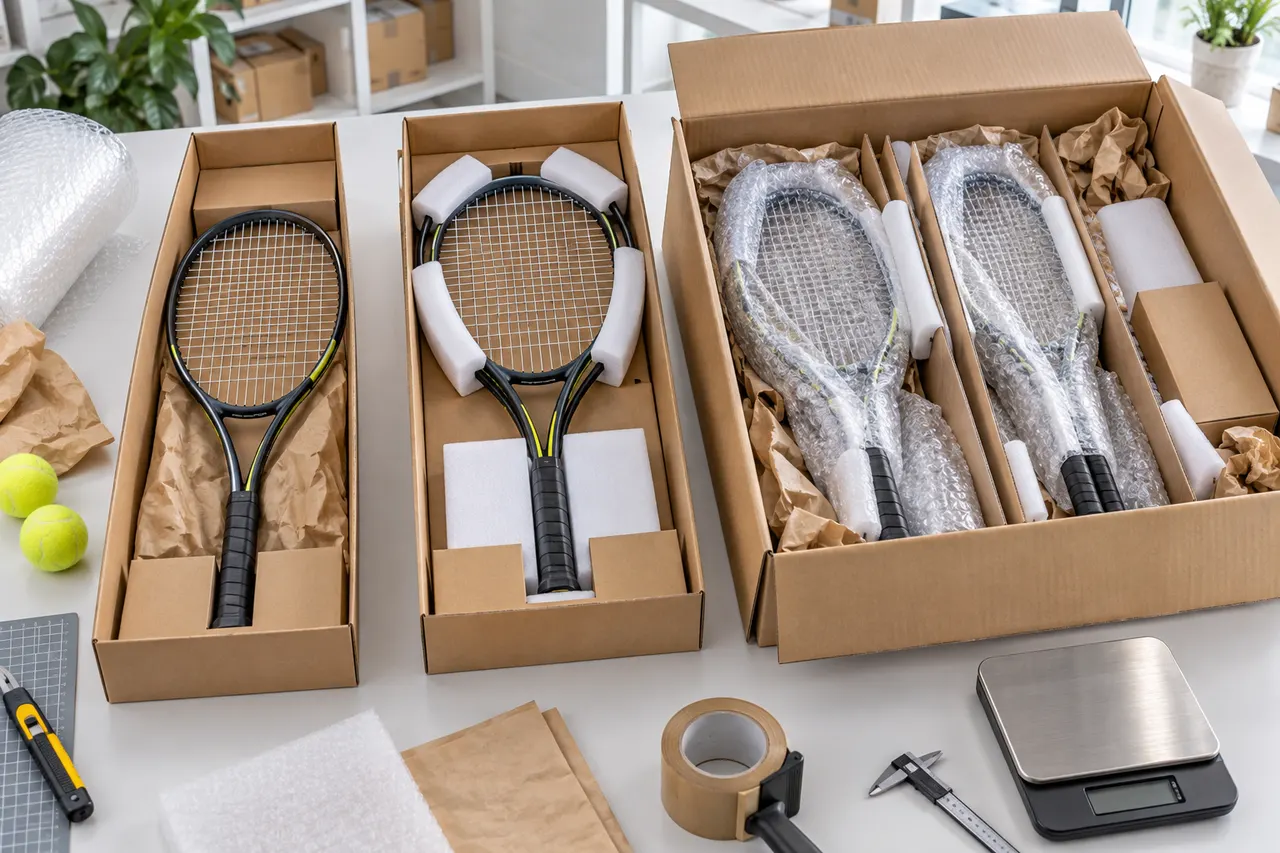
Caption: A comparison diagram of cross-border shipping packaging options for tennis rackets.
Review date: September 9, 2026. This article is based solely on bestkako.org's platform identity, user-visible product images, the ability to note packaging requirements to the agent before ordering, warehouse QC photo review, combined packing, and logistics selection—all executable aspects. It does not claim to have actually purchased, received, or tested any racket. Specific product prices, inventory, shipping costs, route restrictions, and after-sales windows may change; before ordering, refer to bestkako.org's current pages, agent warehouse feedback, and carrier route instructions.
First, determine where the shipping risks come from for this tennis racket
A tennis racket is not the heaviest cross-border item, but its shipping risks are concentrated: the frame is long, has a large stress area, and if the handle and throat are squeezed, it may look like only minor deformation but can actually affect stringing, grip, or future resale. Before choosing a packaging method, don't just ask "what's the cheapest?"; first determine where the risks come from for this racket.
The first risk is frame compression. The elliptical frame of a tennis racket, if pressed by shoe boxes or clothing in the package, or if its edges are pushed by other hard objects, may suffer local dents, paint chips, or deformed grommets during transit. Especially for items without the original hard case, with only a soft cover or bare racket, don't interpret "looks light" as "safe to pack casually." 🎾
The second risk is impact on the handle and butt cap. The handle is often overlooked compared to the frame, but it is the core part for gripping and power. If the packaging only protects the head and the handle end is exposed or close to the box edge, impact from drops may first transmit to the handle end, butt cap, and grip tape.
The third risk is the box size issue caused by length. Tennis rackets usually make the package elongated or require a larger carton. Long boxes are more likely to be stacked, bent, or incur volumetric weight in international shipping. That is, stronger packaging doesn't always mean more economical, but too weak packaging may turn cheap shipping into damage risk.
The fourth risk comes from combined packing. Packing the racket with clothes can provide cushioning; but packing it with shoe boxes, ornaments, metal accessories, or other hard-edged items actually increases the chance of the frame being pressed, poked, or rubbed. Whether combined packing is suitable depends on the items in the same box, not just total weight.
What situations are suitable for separate shipping, frame reinforcement, and combined packing
Separate shipping is suitable for high-value rackets, gifts, items with a specific use date for matches or training, or items lacking original packaging. Its advantage is a simpler package structure, making it easier for the warehouse to protect the racket according to its shape, and when problems occur, it's easier to determine responsibility and take photos as evidence. The downside is that fixed costs may be higher, as the first weight or handling fee cannot be shared with other items.
Frame reinforcement is suitable for most ordinary purchase scenarios. It doesn't necessarily require separate shipping, but requires the agent to provide targeted protection for the frame, handle, both sides of the head, and empty spaces in the box. Common practices include adding bubble wrap, corner protectors, cardboard layers, or keeping the frame from directly touching the box walls. The key here is not the name of the packaging material, but letting the warehouse know "the frame must not be compressed, the handle must not be exposed, and the box must not have movement." 📦
Combined packing is suitable for shipping with soft, low-risk items such as clothing, towels, wristbands, or lightweight racket bags. Soft items can fill empty spaces and reduce the chance of the racket moving inside the box. However, combined packing is not suitable for placing the racket between shoe boxes, hard-shell bags, electronics, or sharp accessories, nor for blindly combining when the route charges significantly by volumetric weight.
If budget is limited, a more reliable order is usually: first confirm product images and QC photos, then request frame reinforcement; if the batch includes mostly soft items, consider combined packing; if the racket is high-value or time-sensitive, prioritize separate shipping. This order is more controllable than asking "which is cheapest" right away.
Use product images and QC photos to confirm the frame, handle, and exposed areas
When selecting a tennis racket on bestkako.org, product images are only the first layer of judgment. You need to see clearly whether the product shows the complete frame, handle, string bed, side thickness, and included packaging. If the page images only show partial views, or if seller photos are too blurry, don't treat them as sufficient basis for packaging decisions.
After the item enters the warehouse, QC photos are the most critical evidence before packaging. You should focus on four areas:
The top of the frame for obvious dents, deformation, or paint chips.
Both sides of the frame for symmetry and intact grommets.
The handle for straightness and the butt cap for looseness or wear.
Whether the item includes the original cover, cardboard box, tags, or protective film.
If the QC photos do not show the sides or handle end, request additional photos. Additional photos are not for nitpicking details, but to decide whether reinforcement is needed, whether to accept the storage condition, and to have comparison evidence in case of shipping damage. 🔍
For used rackets, sample rackets, or rackets without packaging, treat the QC photos as decision-making evidence. Don't just look at one front photo and pay for shipping, because the most problematic areas of a tennis racket are often the sides, throat, handle end, and outer edge of the frame.
Packaging comparison table: protection focus, cost variables, and operational difficulty
The following comparison is not a fixed quote, nor does it guarantee that a certain method will prevent damage. It helps you choose a direction based on item value, route restrictions, and items in the same box.
Method | Suitable situation | Protection focus | Cost variables | Main risks |
|---|---|---|---|---|
Separate shipping | High-value racket, gift, urgent need, no original packaging | Independent carton, cushioning around frame, handle not touching box wall | First weight, long box volume, packaging service fee | Higher fixed costs, possible volumetric weight increase |
Frame reinforcement | Ordinary purchase, most new rackets or lightly used rackets | Head, sides of frame, handle, anti-movement in box | Reinforcement materials, warehouse handling fee, box size | Insufficient reinforcement may still be squeezed by hard items in same box |
Combined with soft items | Batch includes clothing, wristbands, towels, soft bags | Use soft items to fill gaps, avoid direct pressure on frame | Total weight, volumetric weight, route billing method | Higher value after combining, more complex after-sales judgment |
Combined with hard items | Generally not recommended | Need to isolate hard edges and sharp corners | May increase box size and reinforcement fees | Shoe boxes, hard-shell bags, or accessories pressing against frame |
If you can only choose one minimum requirement, prioritize writing "reinforce around the frame, keep the handle not exposed, and prevent movement inside the box." This is easier for the warehouse to execute than just writing "please pack well."
When is it not suitable to force combined packing
The first situation not suitable for combined packing is when the racket price is significantly higher than other items in the batch. The higher the package value, the greater the impact of loss, damage, customs document supplements, or after-sales communication. To save a little fixed shipping cost, stuffing a high-value racket into a complex package may not be worth the risk.
The second situation is when items in the same box have hard edges or sharp corners. Shoe box corners, hard-shell bags, metal buckles, ornaments, or tool accessories may press against the frame during shipping vibrations. If they must be in the same box, require the warehouse to separate the racket from hard objects with cardboard or cushioning layers, rather than letting them touch directly.
The third situation is when the route is sensitive to volumetric weight. A tennis racket may make the box longer, and after combining, the box becomes larger, so the actual chargeable weight may exceed expectations. Before combining, compare estimated weight, box dimensions, and route rules; don't just look at the actual weight of the items.
The fourth situation is when there is a clear deadline. For example, when a match, training camp, birthday gift, or resale delivery date is approaching, packaging and route choices should lean toward stability rather than extreme cost cutting. Delays, additional photos, and repacking all consume time. ⏱️
The fifth situation is when QC photos already show edge defects. If the frame has dents or suspected deformation upon storage, continuing with combined packing will make subsequent responsibility judgment more difficult. In this case, first confirm whether to accept the item's condition, then decide whether to return/exchange, request additional photos, or ship separately with reinforcement.
How to state packaging requirements to the agent before ordering
Packaging notes should be short, clear, and actionable. Don't write long emotional explanations, and don't ask the warehouse to guarantee absolute no damage. A better way is to list the protection areas and inspection actions clearly.
You can use the following Chinese note:
Please focus on protecting the tennis racket frame and handle. Add bubble wrap or cardboard reinforcement around the frame, keep the handle not exposed, and do not place the racket directly against the box wall. If combining with other items, do not let shoe boxes, hard objects, or sharp items directly press on the frame, and fill empty spaces as much as possible to avoid movement. Before shipping, confirm that the outer box has no obvious risk of compression.
If the platform or agent supports English notes, you can also use:
Please protect the tennis racket frame and handle carefully. Add padding around the frame, keep the handle fully covered, and do not place the racket directly against the outer carton. If combined with other items, please separate it from shoe boxes, hard items, or sharp edges, and fill empty space to reduce movement inside the box.
After sending the note, it's best to cross-check with QC photos. If the warehouse provides photos after packing, focus on whether the racket is secured, whether the box is too thin, whether the handle is near the edge, and whether hard objects are in direct contact with the frame. If no post-packing photos are available, at least keep the packaging note and QC photos for later after-sales communication.
After receiving the package, check the frame and grip
After receiving the package, first photograph the outer box, then open it. If the outer box has obvious dents, holes, moisture, or re-taped areas, take photos or videos as evidence before removing the racket. Don't rush to tear off all packaging materials, because damage disputes often require seeing the relationship between the outer box, inner cushioning, and the item's condition.
After taking out the racket, check in the following order:
Look for new dents, cracks, or paint chips on the top and sides of the frame.
Observe the frame from front and side for symmetry.
Check the throat, grommets, and string holes for abnormalities.
Grip the handle and gently rotate to confirm the handle end and butt cap are not loose.
Compare with the warehouse QC photos to determine whether the defects existed before storage or appeared after shipping.
If problems are found, first organize evidence: order information, QC photos, packaging notes, outer box photos, inner packaging photos, detailed damage images, and opening time. Don't just send one close-up of the damage, because the platform or agent needs to determine at which stage the damage occurred.
If only the outer packaging is deformed but the racket is undamaged, record it as a reference for future packaging choices. If the racket itself is damaged, submit materials according to bestkako.org's current after-sales channels, agent rules, and logistics claim conditions. After-sales rules may change; refer to the page display and customer service feedback at the time of submission.
Final choice: decide based on risk, budget, and timeline
If this tennis racket is high-value, lacks original packaging, is for gifting, or must be used soon, prioritize separate shipping with clear frame and handle protection notes. This may not be the cheapest, but the responsibility chain is clearer and packaging control is more direct.
If it's an ordinary training racket, product images and QC photos are clear, and the batch mainly contains soft items like clothing, wristbands, or soft bags, you can choose frame reinforcement plus combined packing. This method may share fixed costs and use soft items as cushioning, but the premise is that the warehouse does not let hard objects directly contact the frame.
If the batch includes shoe boxes, hard-shell bags, metal accessories, or items prone to squeezing, do not force combined packing just to save shipping. Instead, either ship separately or require the warehouse to isolate hard objects and add cushioning materials, then judge whether it's still cost-effective based on estimated volumetric weight.
In the end, use this simple judgment:
Your priority | More suitable choice | Not recommended |
|---|---|---|
Reduce damage risk | Separate shipping or strong frame reinforcement | Bare racket directly combined |
Control total cost | Combine with soft items and confirm volumetric weight | Only look at actual weight, ignore box size |
Urgent need or gift | Separate shipping, reduce variables like additional photos and repacking | Combine first then change route last minute |
Item already has defects | Request additional photos to confirm, then decide return/exchange or ship | Directly combine with doubts |
Savings mainly come from sharing the first weight, reducing separate package fixed costs, and using soft items to fill gaps; increased risks include volumetric weight increase, squeezing by hard items in the same box, concentrated package value, and more complex after-sales judgment. Those suitable for combined packing are buyers who can accept slight delays, are willing to check QC photos, and have batches mostly soft items. Those not suitable are buyers purchasing high-value rackets, demanding flawless appearance, in a hurry, with many hard items in the box, or unwilling to accept shipping damage disputes. ✅
For tennis racket orders on bestkako.org, packaging choice is not just separate shipping versus combined packing, but rather first use product images and QC photos to confirm risks, then write protection requirements clearly, and finally decide based on budget, route, and timeline. This cannot eliminate all cross-border shipping risks, but it can reduce the most common issues of frame compression, handle exposure, and combined packing squeezing to a controllable range in advance.
Frequently Asked Questions About Agent Platform Shopping
1. What categories of products can be found in the spreadsheet on bestkako.org?
The spreadsheet provided by bestkako.org contains multiple categories of products, including footwear, clothing, bags, accessories, jerseys, perfumes, hats, scarves, belts, and various daily necessities.
Browse our latest products and find your next favorite item.